UIUC Legislative Intelligence Platform
AI-Powered Legislative Intelligence for Strategic University Decision Support
The Legislative Intelligence Platform converts unstructured legislative text into standardized intelligence signals, hybrid semantic retrieval systems, and statistically modeled trend insights for institutional decision-making. By combining large language models, adaptive feature standardization, hybrid semantic search, and seasonal anomaly detection, the platform enables the University of Illinois to understand policy direction, detect emerging signals, and assess institutional impact with analytical rigor.
The platform enables leadership to move from reactive policy monitoring to proactive institutional strategy.
This site serves as the central gateway to the platform’s tools, interactive intelligence interfaces, and ongoing research and development initiatives.
Platform Access
Search and Filter Interface
Explore legislation using a hybrid intelligence interface that combines multi-dimensional structured filtering (policy domain, beneficiaries, impact severity, status, date, category) with semantic similarity search powered by vector embeddings. Results are ranked, enriched with standardized AI-extracted features, and support human-in-the-loop validation.
Trends and Visualization Dashboard
Analyze seasonally adjusted legislative activity using 5-year monthly baselines, Z-score anomaly detection, regression-based trend modeling, and directional momentum analysis. The system identifies statistically significant deviations, accelerating categories, and emerging policy shifts. All anomaly detection is derived from historical seasonal baselines and regression-adjusted residual modeling to ensure analytical rigor.
Launch Visualization Dashboard
Legislative Assistant (Conversational AI Interface)
The Legislative Assistant delivers structured, citation-backed analysis of Illinois legislative activity in response to natural language questions. Built within the Microsoft Copilot AI Agent framework using GPT-4.1, it operates in a controlled, session-based environment designed for contextual reasoning and rapid legislative interpretation.
This assistant complements the platform’s deployed semantic retrieval system (MiniLM + FAISS). While the retrieval system supports structured filtering and vector-based similarity search, the Legislative Assistant focuses on synthesis, explanation, and executive-ready insight.
Responses are structured to include:
- Short answer (1–3 sentences)
- What the bill does
- Where it applies / who it affects
- Key dates & status
- Potential UI impacts (clearly marked as interpretation)
- Citations / bill references
Network and Influence Graphs (Legacy Prototype – October 2025)
This feature was originally developed in October 2025 as an early-stage prototype. It demonstrates how LLaMA-extracted features can be used to map relationships across legislative goals, beneficiaries, policy domains, and institutional impact patterns.
We plan to further develop this capability to advance relational intelligence modeling and support deeper cross-domain trend analysis.
View Interactive Legislative Network Graphs →
Status: Under active development
How the Platform Works
End-to-End System Workflow
Below is the complete architectural workflow of the Legislative Intelligence Platform.
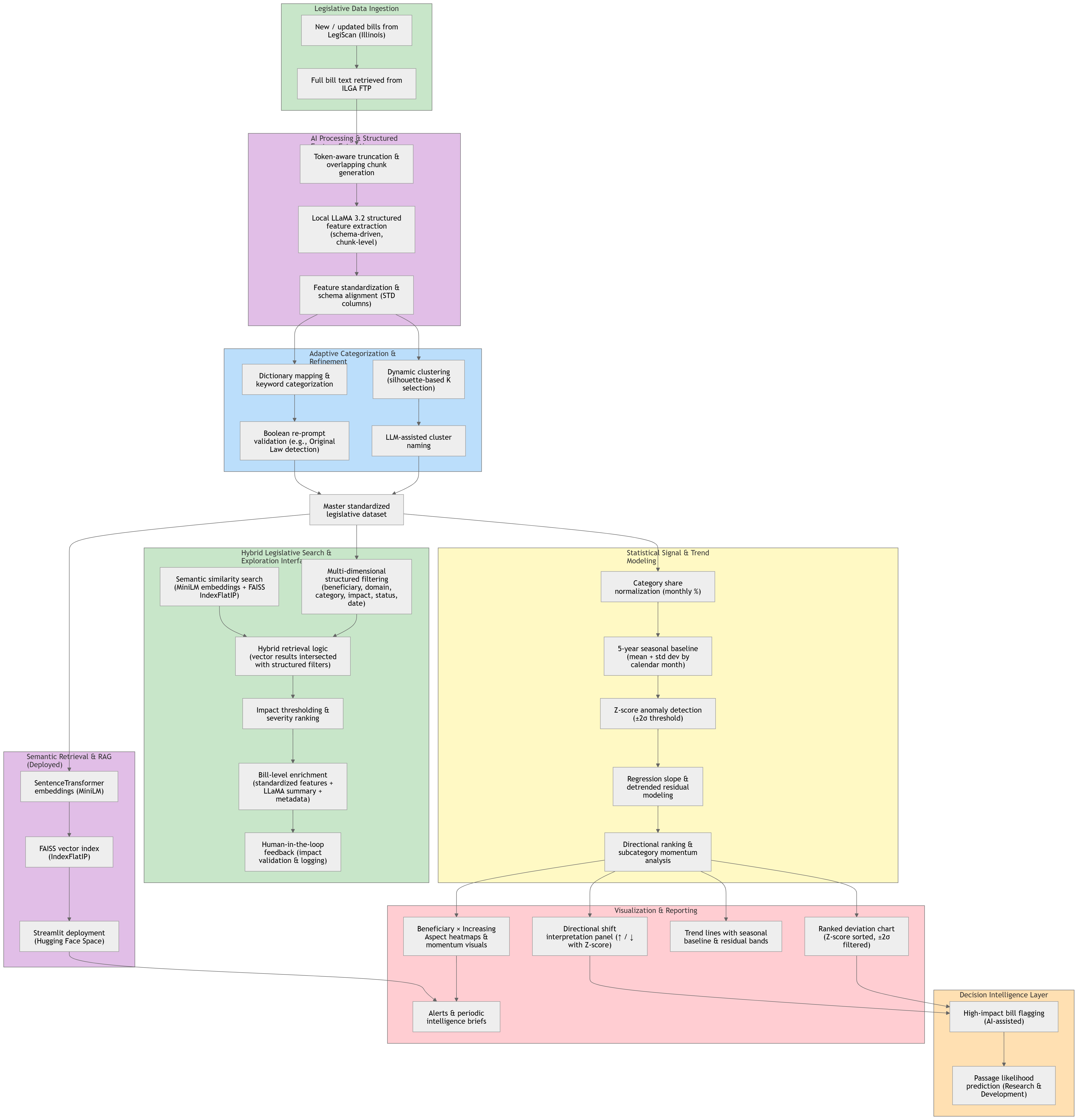
The system follows an end-to-end analytical pipeline:
1. Data Ingestion
Legislative data is sourced directly from LegiScan and the Illinois General Assembly (ILGA) FTP site, ensuring access to official bill text, status updates, and metadata across sessions.
Data is refreshed on a recurring weekly ingestion schedule to reflect newly introduced and updated legislation.
Raw legislative files are standardized into structured, queryable formats for downstream analytics.
Current scope: Illinois legislative data (expandable architecture).
2. Document Chunking
Bills are truncated to safe processing limits and segmented into structured text units to enable scalable large-language-model analysis and retrieval workflows.
Chunking ensures long legislative documents can be analyzed efficiently while preserving contextual continuity.
3. AI-Based Feature Extraction
Large language models extract structured legislative intelligence from each bill, including:
- Llama Summary – Plain-language overview of the bill’s purpose and actions.
- Legislative Goal – The primary intended policy outcome.
- Policy Domain – High-level policy categories or issue areas.
- Key Provisions – Core legal changes introduced.
- Intended Beneficiaries – Stakeholders directly affected.
- Legislative Strategy – Procedural or political design embedded in the bill.
- Increasing Aspects – What the bill expands, funds, authorizes, or strengthens.
- Decreasing Aspects – What the bill reduces, restricts, repeals, or eliminates.
- Category & Subcategory – Assigned political or institutional classification labels.
- Ideological Alignment – Inferred ideological framing when identifiable.
- Potential Impact – Concise assessment of possible implications for UIUC.
- Impact Rating – Structured impact level (Very Impactful, Moderately Impactful, Slightly Impactful, Not Impactful).
- Intent – One-sentence articulation of legislative purpose.
- Motivation – One-sentence explanation of the underlying driver or context.
- Original Law – Referenced statutes or legal frameworks being amended or cited.
These features convert unstructured legislative language into structured intelligence signals.
All AI-generated outputs are structured, standardized, and designed for human review within institutional governance processes.
4. Scoring, Standardization, and Analytical Enrichment
Extracted features are normalized through multiple independent analytical methods, including:
- Adaptive clustering with silhouette-based K selection
- LLM-assisted cluster naming
- Dictionary-based mapping for stable features
- Boolean re-prompt validation for structured signals (e.g., Original Law)
- Feature normalization & schema alignment (STD columns)
- Residual modeling for long-term trend adjustment
Entities (actors, institutions, policy objects) and actions (mandates, appropriations, restrictions) are extracted to construct relationship networks that map how legislative goals connect across domains, enabling advanced network graph analysis and influence modeling.
5. Interactive Exploration
Users access search tools, dashboards, visualization components, and conversational AI tools to explore legislative intelligence at scale.
The platform enables filtering by policy domain, impact rating, beneficiaries, ideological patterns, institutional relevance, and temporal activity.
Platform Vision
The Legislative Intelligence Platform is designed to evolve into a comprehensive institutional intelligence system that supports both active analytical capabilities and ongoing research initiatives.
Active Capabilities
- Early signal detection
- Statistical anomaly modeling with seasonal baselines
- Hybrid semantic + structured legislative retrieval
- AI-assisted executive reporting
- Institutional impact monitoring
Research & Development Initiatives
- Probability-of-passage modeling
- Cross-policy and cross-state influence modeling
- Advanced legislative relationship graph analytics
Contributors
Platform Architect & Technical Lead
Tayler Erbe, Data Scientist
AI Solutions Team Lead & AI Chatbot Lead
Pramod Joshi, AI Coordinator
Data Engineering & Pipeline Architecture Lead
Tejasri Joshi, Data Science Analyst
AI Engineer, Retrieval-Augmented Search Systems
Tanvi Lakhani, Data Science Analyst
Predictive Modeling & Policy Analytics Analyst
Ruchita Alate, Data Science Analyst
Contact
For collaboration, research partnerships, or technical inquiries, please contact the project team.